
The use of colours in terrain models
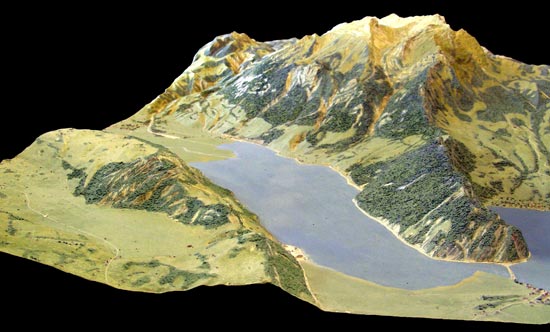
Xaver Imfeld and Carl Meili, 1909,
Glacier Garden Lucerne
Coloured reliefs are more realistic than uncoloured ones, but there are some important rules to consider when choosing colours. First is the choice of the kind of pigment for the colour to be used. To get a realistic effect oil paints are not usually preferred as it makes the surface glossy and flattens the tiny surface roughness of craggy relief parts. For plaster terrains a water-soluble paint, synthetic resin, dispersion or acrylic paint is most convenient [1].
While choosing tints, it is important that the colours selected should not be too saturated [2], in fact, the colours of the model should not match those found in nature. The colours of a terrain model should rather depict the landscape as it appears to the viewer from a few kilometres’ distance. Indeed, looking at the model from several decimetres’ or metres’ distance corresponds to a distance of a few kilometres in nature. But in reality, the atmosphere changes the colours of a landscape when the distance exceeds some hundred meters. The longer the distance between the observer and the landscape, the more the atmosphere influences colours. This effect renders colours lighter, bluer and more assimilated. Therefore, the artist should mix pure colour with a large amount of white, and eventually a touch of blue. Grassland should not be painted with strong green – particularly alpine meadows must be coloured in a light yellow-ochre (-green). Similarly, alpine streams should not be blue but white.
The painting should not compete with the forms of the relief. It only has to support the effect of the shaped miniature landscape; also it must not anticipate a certain direction of illumination. It is best to assume a summer day with equal light cast over the whole sky [3].
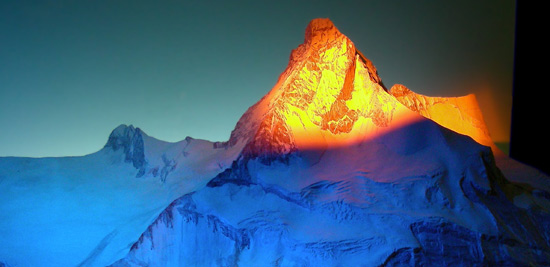
Naturmuseum Winterthur
The colour of a model always depends on the illumination. Thus it is possible to change the colour of the light to simulate different times of the day as demonstrated on Imfeld's relief of the Jungfrau group at the World Exhibition of 1900 in Paris simulating the alpenglow [4].
It is essential that the painter should be familiar with the specificities of the type of landscape being painted and understand the geological processes forming a landscape. Thus, painted reliefs are often able to articulate the geological structure of a landscape. For special tasks reliefs also can be painted in special colours to serve as geologically painted models. But even in this case the colours may not be variegated too much and a pastel-coloured tone is preferred.
[1] Imhof, Eduard. Bildhauer der Berge. 1981. S. 148.
[2] See about this topic for example Heim, Albert. Relief des Säntis in 1/5000. 1904. S.3 or Imhof, Eduard. Bildhauer der Berge. 1981. S. 148,149.
[3] N.N. Das Imfeldsche Relief der Jungfraugruppe. 1902. S.107. after Becker, Fridolin.
[4] Wehrli, Leo. Das Imfeld’sche Jungfrau-Relief und die Entwicklung der Reliefkunst in der Schweiz. 1900. S.238.