
Characteristics of terrain models
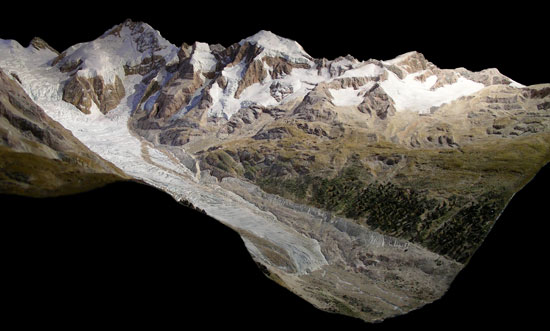
Cartographic terrain or relief models are three-dimensional representations of a part of the earth's surface. They convey an immediate and direct impression of a landscape and can be much easier to understand than two-dimensional maps. The third dimension can only be portrayed in a two-dimensional map through limited cartographic devices, such as contour lines, relief shading and special signatures. These are rather abstract constructions and a map reader requires training and imaginative skills. This is especially true for representations of mountainous regions with steep slopes and rock faces, which have limitations in conventional maps. Alternative paintings or photographs of a rock face can only provide a single point of view. Only with terrain models is it possible to depict the third dimension in its entirety and also on large-scale models a huge amount of topographic details and information can be shown.
Relief models find applications in myriad fields; teaching and education from primary to university levels, in the army (for strategic planning), informing public about infrastructure projects, to facilitate urban and regional planning and the study of geomorphological phenomena.
During the early years of topographic relief depiction – the time before aircrafts and balloons – terrain models were the only way to see the world from a bird’s eye view, and the only one where the observer could choose his/her position freely. Even today terrain models allow for the objective study of landscapes independent of weather conditions and contrasted to virtual models generated by a computer, the physically present model is easier and faster to understand.
But there are some disadvantages for terrain models; the important ones being large space required for their installation and difficulties in transporting them because of the size and weight. Plaster models are most affected by these disadvantages, whereas thermoplastic models are relatively easy to transport. Other disadvantages are their production cost, the long time and huge resources required. New technologies may be able to shorten the production time and reduce the costs but these faster and cheaper techniques do not yet reach the quality of the best handmade plaster models.